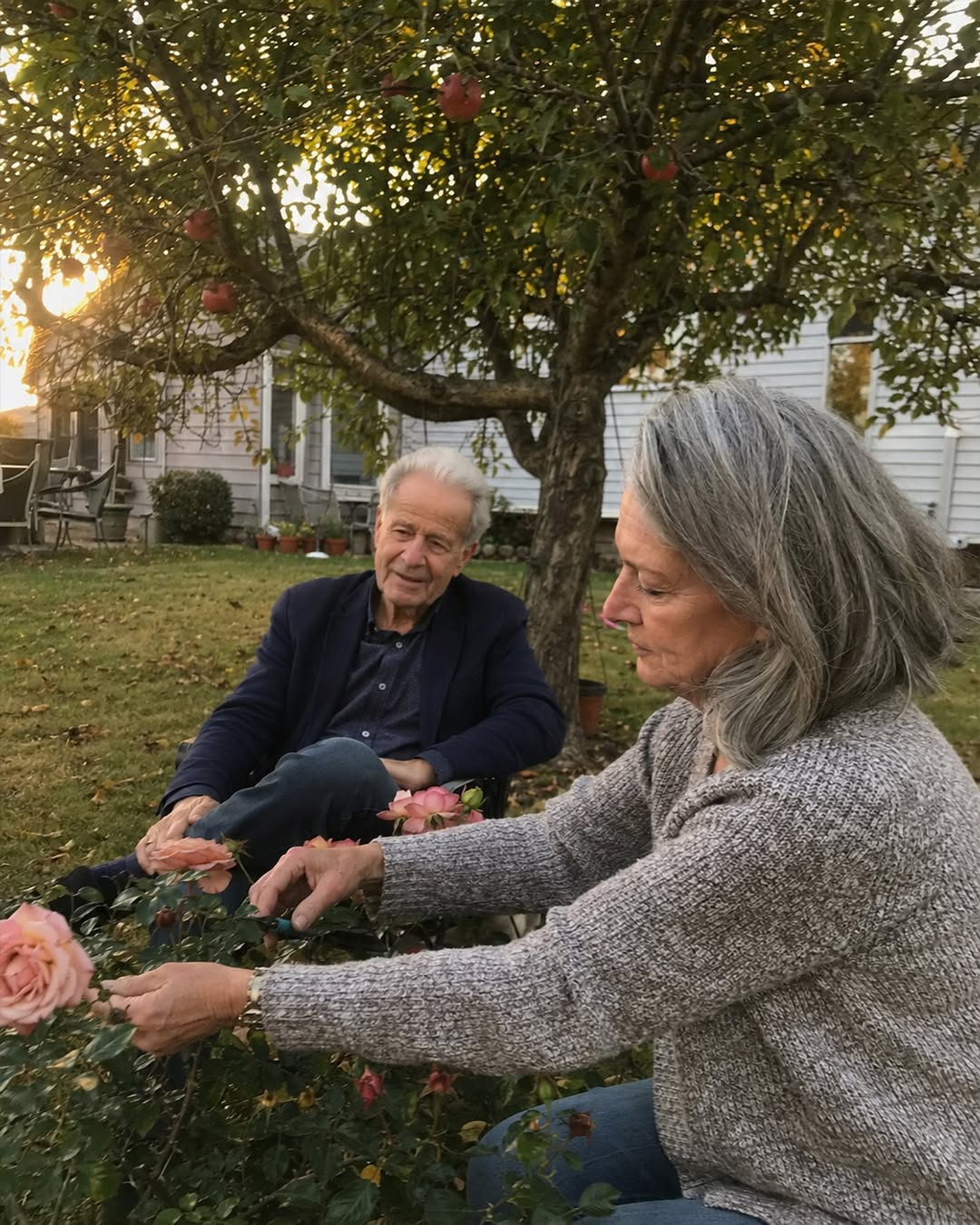
Nigdy nie lubiłem niedzielnych obiadów po odejściu Kathleen.
Przez czterdzieści osiem lat niedziela należała do mojej żony. Wiedziała, jak sprawić, by dom ożywił, nie podnosząc przy tym głosu. Potrafiła włożyć pieczonego kurczaka do piekarnika, przyciąć łodygi kwiatów ze sklepu, poprawić mi krawat dwoma palcami i jakoś zamienić prosty rodzinny posiłek w dowód na to, że życie wciąż ma porządek. Kiedy nasz syn Christian był mały, biegał korytarzem w błotnistych butach, podczas gdy ona go ganiła i jednocześnie się śmiała. Kiedy dorósł, niedziela stała się jedynym dniem, w którym musiał siedzieć naprzeciwko nas i pamiętać, skąd pochodzi.
Po śmierci Kathleen stół stał się zbyt duży.
Dom nie ucichł od razu. Zrobiło się cicho warstwami. Najpierw kapcie zniknęły obok łóżka. Potem jej ogrodnicze rękawice zostały złożone w przedsionku, wciąż zakurzone, nietknięte. Potem czajnik przestał gwizdać o czwartej po południu, bo nigdy nie lubiłem herbaty na tyle, by zrobić ją sam. W końcu nawet stary zegar na korytarzu brzmiał inaczej, każdy ciężki tyk przypominał mi, że czas się nie zatrzymał tylko dlatego, że osoba, która go znosiła, już nie była obecna.
Christian nadal przychodził co drugą niedzielę, ale nie z miłości. Znałem różnicę. Człowiek może dożyć siedemdziesięciu siedmiu lat i stracić wiele rzeczy, ale jeśli zwraca uwagę, nie traci zdolności czytania sytuacji.
Mój syn przyjechał punktualnie o trzeciej tego dnia, piętnaście minut wcześniej niż mu kazałem przyjść. To był jeden z jego drobnych nawyków wyższości. Lubił przychodzić wcześniej, żeby wyglądać na lekko zniechęconego, gdy nie byłem gotów go podziwiać.
Zegar na korytarzu wybił trzecią właśnie w momencie, gdy otworzyłem drzwi.
"Witaj, ojcze," powiedział Christian.
Stał na moim ganku w drogim termometrowym płaszczu, gładko ogolony, wysoki, elegancki i pusty, tak jak czasem bywają odnoszący sukcesy mężczyźni, gdy uważają, że życzliwość jest nieefektywna. Jego żona, Stephanie, stała tuż za nim. Miała na sobie kremowy sweter i trzymała w obu rękach przykryte naczynie, choć nie podeszła już do mnie, by pocałować mnie w policzek tak jak kiedyś.
Był czas, gdy Stephanie nazywała mnie tatą. To było przed ceremonią Kathleen, zanim powiedziałem za dużo przed zbyt wieloma ludźmi, zanim powiedziałem Christianowi, że potrafił odwiedzać matkę wierniej po jej odejściu niż wtedy, gdy czekała, aż usłyszy jego samochód na podjeździe.
Nie żałowałem, że to powiedziałem. Żałowałem, że Kathleen nie była tam, by ścisnąć mój nadgarstek pod stołem i powstrzymać mnie.
"Wejdź," powiedziałem.
Christian przeszedł obok mnie pierwszy, już rozglądając się po holu. Jego wzrok przesunął się po antycznym lustrze, stoliku nocnym, stojaku na parasole, orzechowych schodach, obrazach wybranych przez Kathleen w Vermont. Starał się, by inspekcja wyglądała na swobodną, ale negocjowałem z ministrami i ambasadorami, którzy żyją z kłamstwem. Mój syn nie był ambasadorem.
Był kalkulujący.
Stephanie weszła ciszej. Uśmiechnęła się do mnie, ale uśmiech wyglądał na pożyczony.
"Jak się masz, Hubercie?" zapytała.
"Wciąż tu jestem," powiedziałem.
Christian’s mouth tightened. Stephanie looked down at the dish.
We went into the dining room. I had set the table myself, though not with Kathleen’s care. The plates did not match the napkins. One fork was turned the wrong way. The roast had cooled because Christian’s early arrival annoyed me enough to make me leave it uncovered on purpose.
“You’re late,” I said as I took my seat at the head of the table.
Christian glanced at his watch. “We’re early, Father.”
“That depends on whose clock you use.”
Stephanie closed her eyes for one second, as if gathering patience. I noticed that, too. People often think old men miss details. In truth, age teaches you to preserve your energy for the details that matter.
We ate soup first. Kathleen’s recipe, though mine was thinner and less forgiving. Christian commented on nothing. Stephanie tried once to talk about a picture book she was illustrating for a small publisher in New York. Her voice warmed when she described a fox in a blue raincoat, then faded when Christian did not look up.
Halfway through the meal, Christian placed his spoon down.
“I have news,” he said.
I looked at him. “That sounds rehearsed.”
His jaw moved slightly. “I have a business trip to Prague next week.”
Prague.
The word reached across decades and touched a part of me I had been trying not to visit. Kathleen and I had gone there once in the early eighties, when my diplomatic posting took me through Central Europe. The city had been gray then, watched, restrained, beautiful in a guarded way. Kathleen loved it immediately. She loved the bridge, the castle, the old rooftops, the way the city seemed to hold history in its stone.
For years she had said we would return.
We never did.
“Congratulations,” I said. “Your company finally trusts you with a map.”
Christian ignored that. “I thought you might come with me.”
My spoon stopped in the air.
Stephanie’s hands tightened around her napkin.
“Why would I go to Prague with you?” I asked.
Christian leaned back, too prepared. “Because you always talked about going back. You said you wanted to show Mom the city again. I know that’s not possible now, but maybe we could still go. I’ll have meetings during the day, but evenings would be free. We could walk around, have dinner, see the old places.”
It was the kind of offer a son should have made out of tenderness.
That was why I did not trust it.
Christian had not shown interest in my memories for years. He had tolerated them when Kathleen prompted him. He had smiled through family stories like a man waiting for an elevator. Now he was offering to escort me across the ocean to revisit a city tied to the woman he had barely made time for during her final months.
I looked at Stephanie. She would not meet my eyes.
“What about your wife?” I asked.
“I have deadlines,” Stephanie said quickly. “Illustration revisions. I can’t leave.”
“Convenient.”
Christian sighed. “Father, I know things have been strained since Mom. But you’re sitting in this house alone. You need to get away.”
“I need many things, Christian. Advice from you rarely makes the list.”
His expression flickered, but he kept his voice even. “The company pays for the hotel. It won’t cost you anything.”
That, more than anything, interested me. Christian had always known how to bait a hook with practicality. He expected me to resist sentiment and respect economy.
“I’ll think about it,” I said.
The rest of dinner passed under a low ceiling of silence. Stephanie asked if I wanted more soup. Christian checked his phone under the table. I pretended not to see him do it. When they left, he lingered by the front door.
“Call me by Wednesday. I’ll need to make the arrangements.”
“I know how calendars work.”
He gave me a thin smile. “I’m trying, Father.”
Perhaps he was. That was the problem with family. They knew exactly which old hope still lived in you. They could mistreat it for years, then touch it lightly and make you wonder if you had been too harsh.
After they drove away, I went to my study and pulled out the Prague album.
Kathleen smiled up from the first page, young and bright on Charles Bridge, her hair lifted by wind, her hand tucked into the crook of my arm. I was wearing a suit despite the summer heat because I was insufferable then and probably still am now. She had teased me for it the entire day.
“What do you think, Kat?” I asked the photograph.
Of course, she did not answer. But I knew what she would have said. Give him a chance, Hubert. He is still your son.
Kathleen believed in the long repair of things. I had built a career on recognizing when things could not be repaired at all.
On Wednesday, I called Christian.
“I’ll go,” I said.
He sounded relieved, too relieved. “Good. I’ll book the hotel and tickets. I’ll pick you up Friday morning.”
“I can get myself to the airport.”
“I insist.”
There it was again. The offer wrapped around control.
Still, I agreed.
By Friday, I had packed a careful suitcase: two suits, walking shoes, blood pressure medication, passport, old guidebook, and the photograph of Kathleen on Charles Bridge tucked inside the inside pocket of my jacket. Christian arrived exactly on time, which should have reassured me and did not.
His silver SUV sat in the driveway with several boxes stacked in the back seat.
“What are those?” I asked.
“Product samples,” he said without looking at them. “For the presentation.”
“What products?”
“New antibiotics. European partners. It’s routine.”
Christian worked for a pharmaceutical company, MedGen Global, in international development. He wore his job like armor. At family gatherings, he spoke in acronyms, regions, compliance language, market expansion plans, as if business vocabulary could make a man more substantial.
The boxes in the back seat were sealed, but one label had been partially torn. I saw a name: Baxter Pharm.
Not MedGen Global.
I filed it away.
At the airport, Christian became attentive in a way that felt nearly theatrical. He carried my suitcase, tried to help me with my coat, insisted on sitting beside me near the gate. He checked his phone every few minutes, his face tightening, then smoothing, then tightening again.
“Stephanie?” I asked.
“She worries.”
“About what?”
He did not answer quickly enough. “About the trip.”
On the plane, he gave me the window seat.
“You always liked looking at clouds,” he said.
I had always preferred the aisle. Kathleen liked the window. Christian had misremembered the detail because he had never cared enough to remember it properly.
I let him have his version.
Somewhere over the Atlantic, I asked him about the presentation. He launched into a speech about broad-spectrum coverage, emerging markets, physician confidence, and regulatory partnerships. It was polished until I asked about contraindications.
He faltered.
“Standard,” he said.
“Standard is not an answer. It is a hiding place.”
His shoulders stiffened. “I know the material, Father.”
“You know the slogans.”
After that, we said little.
Prague greeted us with a pale spring sky and streets that seemed both familiar and transformed. A young company representative named Martin met us at the airport holding a sign with Christian’s name. He was polite, efficient, and spoke excellent English. He took us to a five-star hotel in the old city, a converted nineteenth-century building with brass fixtures, marble floors, and staff who moved as quietly as chess pieces.
“Your company spends generously,” I said.
Christian smiled. “Only the best for our partners.”
“And apparently for aging fathers.”
“For you,” he said.
It almost worked.
My room overlooked a quiet courtyard. I unpacked slowly, hung my suits, placed Kathleen’s photograph on the desk, and sat beside the window listening to the hotel breathe. There are places that make loneliness sharper because they are beautiful enough to demand sharing. Prague was one of them.
That evening Christian took me to a basement restaurant with vaulted ceilings, heavy wooden tables, dark beer, and a menu designed to make tourists feel they had discovered authenticity. We ate goulash, dumplings, and apple strudel. He checked his phone eight times before dessert.
“You are either a very important man,” I said, “or a very nervous one.”
He put the phone away. “The meeting is tomorrow.”
“Then stop rehearsing your panic.”
He gave me the kind of look sons give fathers when they want to forget they are still sons.
The next morning, he appeared at my door at seven in a business suit.
“I wanted to make sure you were all right before I left.”
“I survived diplomatic receptions during the Cold War. I can survive a hotel mattress.”
He placed cash and a map on my table.
“For lunch and taxis.”
“I have money.”
“I know. Just in case.”
He paused at the door as if he meant to say something else. For a moment, I saw not the polished executive, not the calculating heir, but the boy who once stood outside my study afraid to admit he had broken Kathleen’s favorite vase.
Then the moment disappeared.
“I’ll see you at two,” he said.
He did not see me at two because I lost track of time on Charles Bridge.
The city was bright that day, washed clean by morning light. Musicians played near the statues. Tourists crowded with phones held high. The river moved beneath the bridge with the calm confidence of something that had watched empires pass and did not feel the need to comment.
I stood where Kathleen and I had once stood, unfolded her photograph, and held it against the view. The old picture and the living city overlapped imperfectly. Time had moved on. So had the country. So had I, though I resisted admitting it.
“I came back, Kat,” I whispered.
When I returned to the hotel, Christian was waiting in the lobby, angry under a mask of concern.
“I was worried.”
“You were waiting.”
“You’re in a foreign country.”
“So are thousands of tourists, most of whom are less qualified than I am to locate a café.”
His lips pressed together. He walked me through the city that afternoon as if I were a dignitary and he were a guide assigned by obligation. He pointed out landmarks I had once explained to his mother in greater detail. Every so often, his phone buzzed, and his mood shifted.
For three days, the pattern continued. He left in the mornings. I explored. We met later. He spoke of meetings without details, business without names, success without evidence. By the fourth day, he announced he had to visit suppliers outside the city and would return late.
“Can you manage dinner alone?” he asked.
“I can operate a fork without supervision.”
He smiled, but his eyes showed guilt and relief.
That was the last time I saw him in Prague.
The next morning, the hotel phone rang. The receptionist told me someone was waiting in the lobby. I went downstairs and found Martin, the company representative, standing with a careful expression.
“Mr. Baxter,” he said. “Your son asked me to inform you that he was called back urgently to headquarters. He left overnight. He asked that I assist you today.”
I stared at him.
“He left without telling me?”
Martin shifted. “He said you were informed.”
“He said many things.”
The young man looked uncomfortable. “I am sorry.”
That was the moment I understood.
Christian had not brought me to Prague to heal anything. He had brought me there to remove me from my own house.
The anger did not come loudly. It came cold, which is the more useful kind.
I thanked Martin, declined his supervision, and returned to my room. Then I checked Christian’s room with the help of a nervous receptionist and a small lie about medication. The room had been cleaned. His things were gone. In the wastebasket, I found a crumpled draft of a note.
Father, I was called home urgently. Please remain in Prague and rest. I will arrange your return next week. All expenses are covered.
He had written a note and chosen not to leave it.
That detail mattered. It meant his plan had changed, or his nerve had failed, or he preferred confusion because confusion slows people down.
He had underestimated me.
At the front desk, I confirmed the hotel was paid for another six days. There was no return ticket in my name that they could locate. Christian had arranged comfort without freedom, the polite version of a locked room.
I called him. No answer.
I called Stephanie. No answer.
I called my neighbor back home. No answer.
Then I did what any retired diplomat with a working passport and a suspicious son should do. I went to the American embassy.
The young officer at the desk listened politely, then explained that since I had my passport, a paid hotel room, and access to funds, I was not technically stranded. He was correct in the narrow bureaucratic sense, which made him irritating.
“Young man,” I said, “I am not asking whether I qualify as a form. I am telling you my son transported me across the Atlantic under false pretenses and returned home without informing me. That is a family problem, yes, but it is also a practical one.”
To his credit, he brought me to a consular officer named Linda Bright. Linda had the composed face of someone who had seen every variation of human foolishness and remained kind by discipline.
When I told her I had served in Eastern Europe in the eighties, her expression changed.
“You served in Prague?”
“For two years.”
She smiled. “Then perhaps Prague owes you a favor.”
Within an hour, Linda had found one.
Milton Harris, a former diplomatic colleague I had not seen in decades, happened to be in the city and was flying home through the same region the next morning. He was visiting his daughter, who now lived not far from my town in Maryland. Linda arranged for us to meet at a café near the embassy.
Milton arrived older, thinner, and still unmistakably Milton. His eyes had the same mischievous intelligence they carried in Budapest when he used to charm information out of people who thought they were charming him.
“Hubert Baxter,” he said, embracing me. “Still impossible to misplace.”
“You look terrible.”
“So do you, but I was raised better than to say so first.”
Over coffee, I told him everything.
Milton listened without interruption. When I finished, he tapped one finger against the table.
“He needed you away from the house for a defined period.”
“Yes.”
“And he assumed you could not return quickly.”
“Yes.”
“Then you should return before he has finished whatever he began.”
That was Milton. No dramatics. No sympathy wasted where action was possible.
By the next evening, we were back in the United States. Milton insisted on accompanying me from the airport to my house. The cab pulled onto my street just after nine. Lights glowed in several windows. Christian’s SUV sat in the driveway. Beside it was an unfamiliar car.
A woman’s coat hung on my coat rack when I stepped inside.
Christian opened the door with a glass of wine in his hand and shock all over his face.
“Father,” he said. “How are you here?”
“I live here.”
He stepped aside. His face had lost color.
From the living room emerged a thin woman with elegant gray hair, an upright posture, and eyes sharp enough to cut ribbon. Agatha Winston. Stephanie’s mother. I had met her at the wedding and twice after that. She had the manner of someone who believed good breeding could substitute for permission.
“Mr. Baxter,” she said. “What a surprise.”
“I was about to say the same.”
Stephanie appeared behind her mother, pale and visibly distressed.
“Hubert,” she said softly. “We weren’t expecting you so soon.”
“That has become clear.”
The living room had already begun to change. New cushions on the sofa. A different vase on Kathleen’s side table. A stack of books I had not purchased. Framed photographs placed where Kathleen’s watercolor had been.
Nothing large enough to call invasion.
Everything small enough to call preparation.
Christian asked that we sit.
I took my chair. He sat beside Stephanie. Agatha sat across from me, calm as a judge.
“Explain,” I said.
Christian began with concern, as dishonest people often do.
“Since Mom passed, you’ve been alone here. The house is too large. You forget things. You get upset. Stephanie and I have been worried.”
“I forget nothing that matters.”
Stephanie looked down.
Christian continued. “Golden Autumn is an excellent assisted-living community. Medical support, activities, private rooms. We thought if you spent time there, just as a trial—”
“You moved your mother-in-law into my house while I was in Prague.”
“We hadn’t finished the conversation,” he said.
“You had not started it.”
Agatha folded her hands. “Christian and Stephanie suggested I come here because my house in Washington has become too much for me. They also thought I could help with the transition.”
“The transition of my home into theirs.”
Christian flushed. “It will be mine eventually.”
“Eventually is not a legal term.”
For the first time, anger broke through his polished surface.
“You are seventy-seven years old, Father. You live in a house built for a family, not one stubborn man surrounded by memories.”
The words reached me, but not in the way he intended. Yes, the house was full of memories. Kathleen in the garden. Christian on the stairs at six years old with a missing front tooth. Ethan, our grandson, asleep on the couch after Thanksgiving. Memory was not clutter. It was evidence that love had once lived here.
“This house belongs to me,” I said. “I bought it with your mother. We paid for it. We chose it. She left this world in the upstairs bedroom with my hand in hers. You do not get to turn my grief into an opening bid.”
Stephanie’s eyes filled, but she said nothing.
Christian looked away.
In that moment, I could have ordered them all out. I could have raised my voice, called a lawyer, embarrassed them, forced a clean confrontation. But diplomacy teaches you that the first visible conflict is rarely the real conflict. Christian had moved pieces on the board. I needed to see all of them.
“All right,” I said.
They stared at me.
Agatha’s brows lifted.
“She can stay,” I said, nodding toward Agatha. “There are enough rooms. But Golden Autumn is not open for discussion.”
Christian’s relief arrived too quickly. He thought he had salvaged half his plan. Stephanie looked confused. Agatha looked thoughtful.
“Thank you, Hubert,” she said.
“Do not thank me yet.”
That night, I lay awake in the bedroom Kathleen and I had shared and let the anger become useful.
Christian believed I was softened by age, grief, and loneliness. He thought I could be moved like furniture if handled with enough confidence. He had forgotten what I did before retirement. I had spent my professional life listening to powerful people say one thing while doing another. I had learned to smile, wait, document, and let arrogance expose itself.
If my son wanted to play patient games, I would remind him who taught him patience.
The first step was Agatha.
At first, we circled each other like diplomats from unfriendly countries. We met in the kitchen at awkward times, exchanged polite comments, and retreated. Christian and Stephanie came by almost every evening, clearly afraid I might reverse my decision and send Agatha back to Washington.
But slowly, Agatha and I began to talk.
One morning, I found her making tea. She moved with the graceful discipline of someone who had spent years training her body. I remembered Stephanie once mentioning ballet.
“You danced professionally,” I said.
She looked surprised. “Thirty years with the Washington Ballet. Not the star everyone remembers, but never decoration.”
“That sounds more honest than most careers.”
She smiled despite herself.
I joined her at the kitchen table. We spoke of performance, discipline, aging bodies, and spouses we had lost. Her husband Henry had been a corporate attorney, gone five years. Mine was a wife who grew roses and corrected my pride more effectively than any supervisor ever had.
Loss made a bridge where suspicion had been standing.
A few days later, Agatha told me what Christian and Stephanie had said to persuade her.
“They claimed you were becoming confused,” she said. “That you refused help. That you were lonely but too proud to admit it. Stephanie said the house was becoming unsafe for you.”
“And you believed them?”
“Not entirely. But children see things outsiders miss.”
“Children also invent things that help them sleep at night.”
She studied me for a long moment.
“You are not confused, Hubert.”
“No.”
“And you are not helpless.”
“No.”
“But you are angry.”
“At last, an accurate diagnosis.”
That was the beginning of our alliance, though she did not yet know we were allies.
Agatha told me more over the next week. Christian and Stephanie’s marriage was strained. He came home late. He guarded his phone. Stephanie suspected there was another woman, though she had no proof. She also worried about money, not because they were poor, but because Christian’s spending had changed. Dinners, hotels, unfamiliar charges, “business expenses” that did not quite fit.
At the same time, I began looking into the name I had seen on those boxes: Baxter Pharm.
The name appeared in small international directories, connected to low-cost pharmaceutical distribution in emerging markets. It was not part of Christian’s employer. It was not disclosed in his professional biography. It was precisely the kind of side venture that could end a corporate career if handled carelessly.
I did not need to break into anything. Christian had made the mistake of leaving his life arranged for convenience, not secrecy.
Kathleen had insisted years ago that we exchange emergency keys with Christian and Stephanie. One Saturday, while Stephanie and Ethan were away and Christian was supposedly at work, I entered their house.
I am not proud of that part. I am simply honest about it.
Christian’s office was painfully neat: diplomas on the wall, industry books on shelves, desk drawers labeled in the same tidy handwriting he had used since school. In the lower drawer, beneath a false stack of trade magazines, I found a folder containing contracts under Baxter Pharm. Several involved overseas distributors. Some concerned medication lots near the end of their approved sales window. Others were structured through intermediaries in a way that suggested Christian knew direct questions would be inconvenient.
I photographed the documents and returned them exactly as I found them.
In a jacket pocket upstairs, I found receipts. Restaurants. A boutique hotel downtown. A jewelry store. A business card with a woman’s name written in elegant black font: Tanya Evans. On the back, a hotel address and a time.
I did not feel triumphant. Not yet.
The best evidence is not the evidence you rush to use. It is the evidence you let mature until the person who needs to see it cannot look away.
The opportunity arrived in the form of an invitation.
The Mid-Atlantic Pharmaceutical Association held an annual charity dinner at a hotel downtown. I had been a consultant in the sector after retiring from diplomatic service, advising on international compliance and market entry. I still received invitations, though I usually ignored them. This year, Christian’s employer would be represented.
I put on my best navy suit, the one Kathleen said made me look less severe if I remembered to smile. I did not remember.
The banquet hall was bright, crowded, and full of people who laughed as if networking were a moral obligation. Doctors, executives, consultants, foundation directors, compliance officers, and men who wore name tags too low on their jackets. I spotted Christian almost immediately.
He stood with a group from MedGen Global, holding champagne and speaking animatedly. Beside him was Tanya Evans in a black dress, laughing with her hand briefly touching his sleeve. The gesture lasted less than two seconds. It said enough.
Robert Hedges, an old industry acquaintance, found me near the hors d’oeuvres and nearly crushed my shoulder in greeting.
“Hubert Baxter. I thought you had retired from human nonsense.”
“I tried. Human nonsense remained active without me.”
Through Robert, I was introduced to Henry Stone, MedGen’s director of development, and Victoria Palmer, head of ethics and compliance. Victoria had clear eyes and the guarded posture of someone paid to notice risk before it became public.
We spoke of regulation, charitable distribution, gray markets, and the reputational cost of shortcuts.
Then I said, “That is why I was surprised to see Baxter Pharm appearing near some of your international channels.”
Henry frowned. “Baxter Pharm?”
Victoria’s attention sharpened. “What connection are you referring to?”
“I would rather be wrong,” I said, handing over copies of the documents. “But if one of your managers has an undisclosed commercial interest in a parallel distribution company, and that company is moving products through sensitive markets, you may want to review it before someone less friendly does.”
Victoria looked at the first page. Then the second.
“Who is the manager?”
“My son,” I said. “Christian Baxter.”
The silence that followed was professional, contained, and very effective.
Henry Stone excused himself first. Victoria stepped away to make a call. Christian noticed within minutes. His expression shifted from confidence to confusion, then to fear. He crossed the room quickly and caught my elbow.
“What did you do?” he whispered.
“I attended a dinner.”
His grip tightened just enough to be disrespectful, not enough to be useful to him.
“Tell me what you said.”
“I said the truth had become overdue.”
His face went pale. “You have no idea what you’re interfering with.”
“I know exactly what I am interfering with. A pattern.”
“You’re destroying my career.”
“No,” I said quietly. “I am declining to protect it from you.”
He swallowed hard.
“Does Stephanie know about Tanya?” I asked.
His eyes widened.
I looked toward the woman in black, who had stopped laughing and was watching us from across the room.
“Careful, Christian. When a house has too many locked rooms, even the people who live there eventually start checking doors.”
I left him standing under the chandelier with his champagne untouched.
When I returned home, Agatha was waiting in the living room with a book open in her lap, though I could tell she had not been reading.
“How was the dinner?”
“Educational.”
I told her I had seen Christian with Tanya. I did not tell her yet about the compliance documents. A good strategy does not reveal all its pieces to the wrong person, even when that person is becoming the right person.
Agatha’s face hardened.
“Stephanie asked me about a woman last week,” she said. “She tried to make it sound casual. It wasn’t.”
The phone rang before we could say more.
Stephanie.
Her voice trembled.
“Hubert, Christian said he was working late, but the dinner ended, didn’t it?”
“Yes.”
“Was he there with someone?”
I let the pause do some work.
“Come for breakfast tomorrow,” I said. “Bring your mother. We should speak in person.”