Stephanie began to cry quietly, the way people cry when they already know and are only asking for the dignity of confirmation.
By morning, Christian had been suspended pending internal review. By noon, he was officially separated from the company for undisclosed conflicts and ethics violations. His side business would be reviewed by regulators and counsel. The carefully built professional image he had worn to Sunday dinners folded in less than a day.
Stephanie arrived at my house with red eyes. Christian followed two hours later, unshaven and furious.
“You’re satisfied now?” he said. “You’ve damaged my career, my marriage, everything.”
Stephanie stood near the fireplace, arms folded around herself. Agatha sat beside her, one hand on her daughter’s knee.
“You did this,” Stephanie said, and her voice was quiet enough to make him flinch. “The hotels. Tanya. The hidden company. The lies about Prague. All of it.”
Christian looked from her to me.
“You turned them against me.”
“No,” I said. “You simply left them fewer excuses.”
Stephanie announced she was taking Ethan to Washington with Agatha while she decided what came next. Christian protested, pleaded, accused, and finally left after realizing no one in the room was available to be controlled.
The house became quiet after they went.
For the first time since Prague, the quiet did not feel empty. It felt like a room after bad weather has passed through with the windows open.
Agatha stayed two more days before leaving with Stephanie and Ethan. At the airport, she surprised me by touching my arm.
“I misjudged you,” she said.
“I encourage people to do that. It gives me time.”
She smiled. “I thought you were simply a difficult old man.”
“I am.”
“No. You are a principled one. Difficult is only the packaging.”
I did not know what to say to that, so I said nothing.
After she left, I did the one thing I should have done years earlier.
I called Lawrence Hope, my attorney.
“Hubert,” he said when his secretary connected us. “This is unexpected.”
“I need to change my will.”
The silence on the line changed shape.
“How soon?”
“Today.”
Lawrence had known me long enough not to waste time asking whether I was serious. By four o’clock, I sat in his office with deeds, account records, foundation documents, and the calm certainty of a man who had finally stopped confusing inheritance with love.
“I want Christian removed as primary heir,” I said.
“That is significant.”
“He can receive a modest fixed amount, enough to prevent claims that I forgot him. The majority of the estate goes to the Kathleen Baxter Foundation for Young Diplomats.”
Lawrence made notes.
“And the house?”
I looked out the window at the late afternoon light on the city.
“Half in trust for Ethan. Half to Agatha Winston, with a life estate allowing me to remain there as long as I live.”
Lawrence looked up.
“Agatha Winston?”
“She has shown more respect for my home in three weeks than my son has in ten years.”
“Christian may contest this.”
“Let him. I have documentation.”
The will was drafted, reviewed, and signed. But Christian did not wait for my passing to challenge the idea. Within a week, Lawrence called again.
“He is claiming undue influence,” Lawrence said. “He suggests Agatha manipulated you.”
“Of course he does.”
“He may also attempt to raise questions about your capacity.”
I laughed once, without humor. “The man who left me in Prague now worries I cannot manage travel?”
“There is a stronger option,” Lawrence said. “We create the trust now. Transfer the house into it while you are independently evaluated and formally deemed competent. You reserve the right to live there. It becomes much harder to challenge later.”
“Arrange it.”
The evaluation took place two days later. The doctor asked me to remember words, interpret scenarios, count backward, identify risks, explain my decisions, and describe why I wanted the trust created. I answered plainly.
“My son treated my age as an opportunity. I am ensuring he cannot profit from that mistake.”
The doctor signed the report.
The notary witnessed the trust documents.
The house was no longer a prize waiting for Christian’s patience.
It was protected.
When I told Christian in person, I found him in his own house surrounded by the wreckage of a life he had assumed would rearrange itself around him. Dishes in the sink. Curtains half closed. A glass on the coffee table though it was still morning.
“You can’t do that,” he said when I told him.
“I already did.”
“It’s a family home.”
“Then it is fortunate Ethan remains family.”
“And Agatha?” His voice cracked with disbelief. “You gave half the house to my wife’s mother?”
“I placed half in her care. She will respect it. You only desired it.”
He paced, ran his hands through his hair, stopped, and tried one final door.
“Mom would be ashamed of you.”
My voice went cold.
“Your mother would have opened the front door herself and invited Agatha in after learning what you did.”
He sat down heavily.
“What can I do?”
“Tell the truth to your son. Apologize to your wife without asking what it will earn you. Find honest work. Live smaller. Become better.”
“And the house?”
“The house is gone from your reach.”
When I left, he said, “You’ll regret this.”
I turned at the door.
“No, Christian. I have regretted tolerating too much. This feels different.”
Agatha returned two weeks later.
I met her at the airport with yellow roses because she had once mentioned them and I had surprised myself by remembering. When she saw the flowers, her face softened in a way that made me suddenly self-conscious.
“You remembered.”
“I am not as forgetful as advertised.”
She laughed, and the sound followed us all the way to the car.
Back at the house, she noticed the new curtains in her room, the fresh linens, the space I had cleared on the bookshelf. Nothing grand. Nothing presumptuous. Just proof that someone had prepared for her arrival rather than occupying a room around her.
Over dinner, I told her the trust had been finalized.
She set down her fork.
“Hubert, that is too much.”
“No. It is precise.”
“We have known each other only a short time.”
“Time is not the same as character. Christian had decades and used them poorly. You had weeks and showed me who you were.”
Her eyes glistened, but she did not look away.
“I don’t want your house.”
“I know. That is one reason I trust you with it.”
The months that followed were quieter than any victory I had imagined.
Stephanie filed for divorce. Ethan visited in the summer, taller than I remembered and more watchful than a young man should have to be. He asked me about Prague, but not the way adults asked. Adults wanted scandal. Ethan wanted to know how it felt to stand on Charles Bridge again without Kathleen.
“It hurt,” I told him. “And it helped.”
He nodded, as if that made sense to him.
Christian called twice. The first time he was angry. The second time he was tired. I answered both calls and offered neither cruelty nor comfort. He had work to do that no inheritance could do for him.
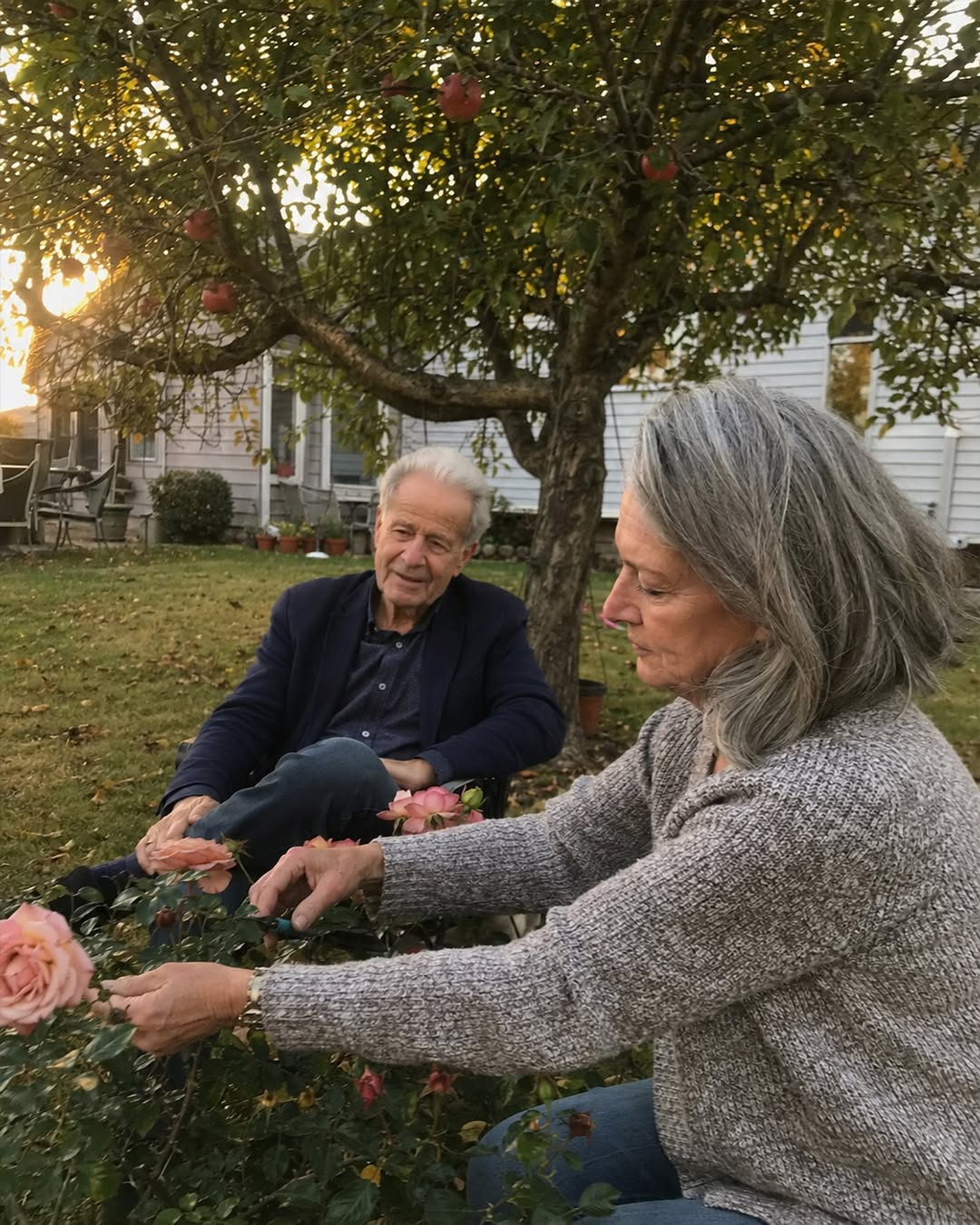
Agatha and I developed a routine so naturally that it felt discovered rather than created. Breakfast in the kitchen. Separate reading in the afternoon. Walks when the weather cooperated. Evenings in the garden where Kathleen’s roses, neglected for nearly a year, began to come back under Agatha’s patient hands.
I sometimes felt guilty about that, then realized Kathleen would have scolded me for treating loneliness like a vow.
One September evening, Agatha and I sat under the apple tree while the last light moved across the lawn. The old hallway clock sounded inside the house, three deep notes out of habit though it was not three. It had begun losing time. I would need to have it repaired.
“Do you miss her every day?” Agatha asked.
“Yes.”
“Does that make this strange?”
I considered lying out of politeness. Then I chose the habit that had saved me.
“Yes,” I said. “But not wrong.”
Agatha smiled faintly.
“No. Not wrong.”
That was the truth Christian had never understood. A house is not valuable because someone can claim it later. It is valuable because of what is honestly lived inside it. Kathleen and I had filled it with a marriage, with arguments, with ordinary mornings, with medical bills, with Christmas lights, with silence, with forgiveness, with the hard furniture of a real life.
Christian had seen square footage.
Agatha saw rooms.
Ethan saw history.
I saw, at last, a future.
People will tell you that age makes a person weak. That grief makes a person easy to guide. That loneliness turns a house into an opening someone else can step through. Sometimes that is true. Sometimes people who love you badly will use your sorrow as a convenient doorway.
But there is another thing age can make you.
Patient.
Precise.
Finished with pretending.
Christian thought he had left an old man in Prague.
What he actually did was give a retired diplomat time to remember who he was.
He gave me a city full of old memories, an embassy full of useful people, a friend named Milton with enough loyalty to bring me home, and one clear view of the truth: my son was not waiting for me to pass gracefully from one stage of life to another. He was trying to hurry the story toward a chapter that benefited him.
So I rewrote it.
I removed him from the center.
I gave my grandson protection, my foundation purpose, Agatha a place of honor, and myself the peace of knowing that the house Kathleen and I built would never become a trophy for impatience.
The hallway clock still strikes too loudly.
The roast still comes out a little dry.
Sometimes, when Agatha and I sit at the Sunday table, I look toward the empty chair where Kathleen used to sit and feel the old ache settle beside me like a familiar guest.
Ale dom już nie czeka na przejęcie.
Jest zamieszkana.
I to, po wszystkim, jest najcichszą sprawiedliwością ze wszystkich.