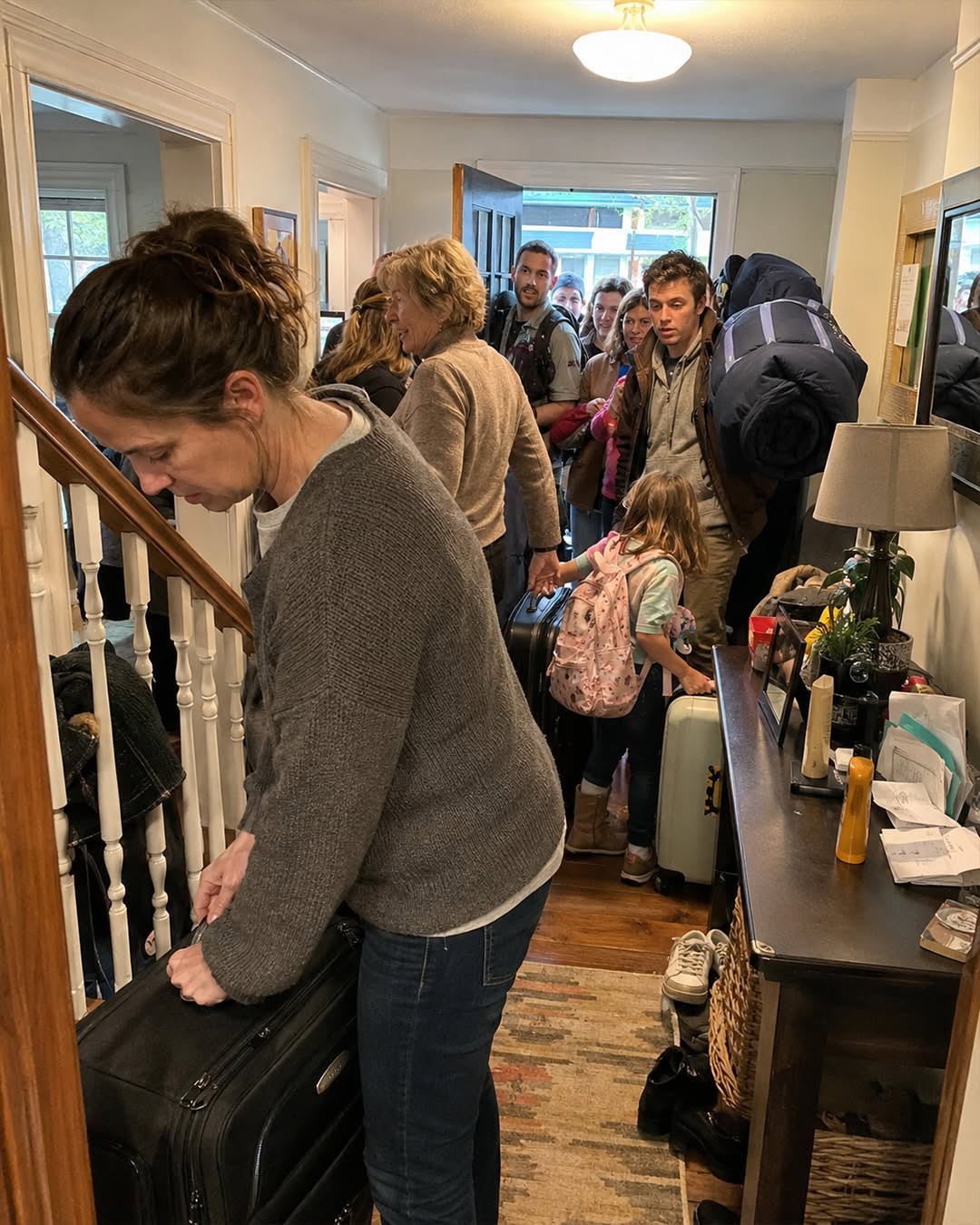
W dniu urodzin mojej teściowej przybyło 75 gości, a mój mąż ogłosił, że wszyscy zostaną u nas przez miesiąc. Cicho podniosłam torebkę i wyszłam. Godzinę później zadzwonił w panice i zapytał: "Dlaczego zamroziłeś karty?"
Pierwszą rzeczą, którą zauważyłem, był bagaż.
Nie ludzie. Nie hałas. Nawet kolejka samochodów nie oplatała naszego cichego ślepego zaułka, jakby ktoś pomylił nasz dwupokojowy dom z hotelem. To bagaż sprawił, że prawda wylądowała w mojej piersi czystym, ostatnim kliknięciem.
Walizki z twardą skorupą. Bagaże podróżne. Plastikowe pojemniki na przechowywanie. Stos złożonych materacy dmuchanych związanych sznurami bungee. Ktoś przyniósł chłodziarkę wystarczająco dużą na tyle dużą, by zjechać na tylne drzwi. Ktoś inny niósł biały kosz na pranie wypełniony ręcznikami, papierowymi talerzami i kawą marki supermarketu. Dzieci wyskakiwały z SUV-ów w trampkach i bluzach, goniąc się po chodniku, podczas gdy dorośli stali w małych grupkach z telefonami, torbami z prezentami i poduszkami na noc.
Moja teściowa, Sharon, stała na środku mojego podjazdu w jaskrawej koralowej sukience i perłowych kolczykach, witając ludzi jak królowa przyjmująca gości w kurorcie, który posiada.
Stałem przy oknie z kubkiem kawy w ręku i obserwowałem, jak mężczyzna, którego nigdy wcześniej nie spotkałem, podnosi dwie walizki z bagażnika wynajętego samochodu.
Za mną mój mąż Liam powiedział niemal dumnie: "Mama chciała, żeby wszyscy czuli się mile widziani."
Odwróciłem się powoli.
Liam się uśmiechał. Nie nerwowo. Nie przepraszam. Uśmiecha się tak, jak mężczyzna uśmiecha się, gdy oczekuje pochwały za hojny gest, który nic go nie kosztował, bo ktoś inny wykona tę pracę.
"Co to znaczy?" Zapytałem.
Pocierał kark, nawyk, który miał za każdym razem, gdy wiedział, że zdanie już przekroczyło granicę.
"Cóż," powiedział, "oni zostają tutaj."
Spojrzałem przez okno. Za pozostałymi podjechał kolejny samochód. Nastoletni chłopak wysiadł z konsolą do gier pod pachą. Kobieta w spodniach do jogi pomachała Sharon i wskazała na nasze drzwi wejściowe, jakby pytała, gdzie ma zanieść swoje rzeczy.
"Ilu?"
Uśmiech Liama zbladł. "Nie wszystko naraz."
"Ile, Liam?"
Spojrzał na korytarz, potem na salon, a potem z powrotem na mnie. "Siedemdziesiąt pięć osób przyjeżdża na weekend urodzinowy mamy. Ale będzie się obracać. Niektórzy zostają kilka dni, inni tydzień. Niektórzy mogą zostać cały miesiąc. To rodzina."
Kawa w mojej dłoni nie była już gorąca, ale wciąż czułem ciepło kubka na dłoni. Skupiłem się na tym. Jedna mała, prawdziwa rzecz.
"Mówiłeś, że impreza jest w restauracji."
"Tak jest."
"Mówiłeś, że nikt tu nie mieszka."
"Mówiłem, że coś wymyślimy."
"Nie," powiedziałem. "Powiedziałem nie. Powiedziałeś, że rozumiesz."
Wypuścił powietrze, teraz zirytowany, jakbym był trudny w dokładnym zapamiętywaniu słów.
"Hannah, to sześćdziesiąte urodziny mojej mamy. Ludzie przylatywali. Ludzie przyjeżdżali z trzech stanów dalej. Co miałem zrobić, powiedzieć im, że moja żona ich nie chce?"
The word wife sat between us, not as love, but as blame.
Outside, Sharon looked up and saw me through the window. She smiled broadly and lifted both hands in a little celebratory wave. Behind her, a woman I recognized vaguely as Liam’s cousin began pulling a collapsible cot from the back of a minivan.
I set my coffee mug in the sink.
Then I picked up my purse from the kitchen island.
Liam blinked. “Where are you going?”
I walked past him into the bedroom. He followed me, talking quickly now.
“Hold on. Don’t make this dramatic. We’ll manage. Grandma can have our room. We can sleep on the pullout couch. The kids can camp in the living room. Barry and Denise can take the office. Mom already made a schedule. It’s actually organized.”
The suitcase was on the top shelf of the closet. Black. Hard-sided. The one I used for work trips. I pulled it down, placed it on the bed, and unzipped it.
Liam stopped in the doorway.
“Hannah.”
I folded two pairs of jeans and set them inside. Then three sweaters. A dress. Underwear. Socks. Toiletries. My laptop charger. Passport. A folder with copies of our property agreement and bank documents. I moved carefully, not quickly, because I had learned years ago that calm frightens people more than shouting when they know they are wrong.
Liam stepped into the room. “You’re not actually leaving.”
I opened the jewelry tray on my dresser and took my grandmother’s watch. “Yes, I am.”
“Because my family is visiting?”
“Because you gave away my home.”
His face reddened. “Our home.”
“You just turned it into your mother’s lodging plan without asking me.”
“I thought you’d understand.”
“You thought I would give in once they were standing on the driveway.”
That sentence stopped him.
Only for a second.
Then he recovered. “They’re already here. You want me to embarrass my mother in front of everyone?”
I zipped the suitcase.
“No,” I said. “You already did that. You just expected me to pay for it.”
He looked genuinely confused.
That was the worst part. He did not think of our credit card, my cooking, my cleaning, my groceries, my time, my privacy, or my sanity as things that could be spent. He thought of them as air. Always available. Always assumed.
I rolled the suitcase to the hallway.
The front door opened before I reached it. Sharon swept inside with the smell of expensive perfume and birthday flowers.
“There she is,” she sang. “Our hostess.”
Behind her, the entryway filled with bodies, coats, gift bags, and cheerful voices. Someone set a box of pastries on my console table. A little girl dragged a pink suitcase over my hardwood floor. An older aunt hugged Liam and said, “Your mother said Hannah has everything ready.”
Sharon looked at my suitcase.
Her smile tightened by one careful inch.
“Going somewhere, dear?”
I met her eyes.
“Yes.”
Liam gave a short, nervous laugh. “She’s upset. We just need a minute.”
Sharon stepped closer, lowering her voice enough to sound private but not enough to keep the nearest relatives from hearing.
“Hannah, don’t start this today. It’s a family milestone.”
“It is,” I said. “Enjoy it.”
Her face cooled. “People have traveled a long way.”
“They should have confirmed where they were staying.”
Sharon’s mouth opened.
I did not wait for the reply.
I put on my coat, picked up my purse, and walked out of the house.
The driveway went silent in waves. First the cousins near the minivan. Then the aunt holding pastries. Then the kids stopped long enough to notice the adults had stopped moving. I could feel everyone watching the suitcase wheels bump down the front walk.
Liam came after me in socks.
“Hannah, come back inside.”
I reached my car and opened the trunk.
“Don’t do this in front of everyone,” he said.
I lifted the suitcase in and shut the trunk.
“That’s an interesting thing to say after you invited everyone to sleep in front of me.”
His eyes flicked toward his mother, then back to me. “Please. Just come in. We’ll talk privately.”
I looked at the line of cars, the coolers, the air mattresses, the smiling relatives who were beginning to understand the weekend was not unfolding the way Sharon had promised.
“We had the private conversation,” I said. “You ignored it.”
Then I got in my car and drove away.
I did not speed. I did not cry. I did not look in the rearview mirror until I reached the stop sign at the end of our street. When I finally glanced back, Liam was still standing in the road in his socks, one hand on top of his head, while Sharon gestured sharply with both hands like a woman trying to conduct a storm.
My phone began vibrating before I reached the main road.
I turned it face down on the passenger seat.
The road out of our neighborhood curved past a school football field, a church with a white steeple, and a coffee shop where Liam and I used to stop on Saturday mornings before marriage became a negotiation I was expected to lose quietly. It was October in North Carolina, bright and cool, with red leaves gathering along the curb and pumpkins lined neatly on porches. The kind of morning that should have belonged to errands, coffee, and a birthday lunch I had already agreed to help pay for.
Not seventy-five guests sleeping on my living room floor.
At the red light near the pharmacy, I pulled into the parking lot and stopped the car.
Then I opened my banking app.
This was not a rage decision. I had made the decision months earlier, in pieces.
The first piece came when Liam invited three college friends over for a weekend without telling me. I came home after a twelve-hour client deadline to find men I barely knew eating pizza at my coffee table while someone smoked on the balcony. Liam said, “They’re just here for the game.” I told him, “They leave tonight or I do.” He laughed at first. Then he saw the suitcase. They left.
The second piece came when he signed us up for a private gym membership without asking me because “the discount was ending.” One thousand dollars charged to the joint card. I told him to cancel it. He said it was nonrefundable. I started packing again. The money was refunded by dinner.
The third piece was Sharon.
Sharon did not visit. She occupied. She rearranged my pantry. Criticized my curtains. Asked why I worked so much if I still could not keep a proper house. She told Liam he looked thin while eating food I had cooked after coming home from work at seven. She referred to my office as “the little spare room,” even though my salary paid half the mortgage and nearly all our savings.
The final piece began three weeks before her birthday, when Liam started saying “family” in the tone people use when they want one woman to provide the labor for a group decision.
I agreed to contribute six thousand dollars toward the restaurant party. That was already more than generous. I said it once, clearly, at the kitchen table. No houseguests. Not three. Not ten. Not for one night. We have two bedrooms, one office, one bathroom downstairs, and no space for a family reunion disguised as a sleepover. Liam nodded. He promised.
Then I noticed his phone lighting up at dinner every night.
Sharon. Cousin group chat. Uncle Barry. Aunt Denise. “Bring sleeping bags.” “Hannah is organized.” “The house is close to everything.” “No need for hotels.”
He thought I did not see.
I saw enough.
At the pharmacy parking lot, I transferred my share out of the joint checking account. I did it cleanly. The balance had been $8,920. I moved $4,460 to my personal account. Exactly half. Then I moved the additional $2,300 I had deposited the week before for my portion of the restaurant bill, because the restaurant had not yet charged it and I was not paying for a celebration built on a lie.
I left Liam’s half in the account.
Then I opened the credit card app.
The card was in my name. Liam was an authorized user. The restaurant had my card on file for the banquet balance because Sharon had insisted it would be “simpler” if I handled the payments. The bakery deposit was attached to the same card. The rental company for folding tables had the same card. The grocery delivery Sharon scheduled for “family breakfast supplies” had the same card.
I pressed freeze.
The screen asked me to confirm.
I did.
Card frozen. Authorized user access suspended.
My phone vibrated so hard against the passenger seat that it nearly slid to the floor.
I ignored it.
Next, I removed Liam’s access from my personal checking account. I had added him a year earlier for emergencies. There had been no emergency, only entitlement waiting for an opening. I changed the password, enabled a new verification method, and saved the confirmation screenshots in a folder labeled October.
Then I drove to a hotel near Raleigh-Durham International Airport and checked into a room under my own name with my own card.
The lobby smelled like coffee and lemon cleaner. A college football game played silently on the television above the fireplace. The front desk clerk asked if I needed anything else. I almost laughed. What I needed was a husband who understood the word no, a mother-in-law who did not treat my life like a venue, and a time machine to recover the eight years I spent hoping boundaries could teach respect to people who only understood consequences.
Instead, I said, “No, thank you.”
In the room, I placed my suitcase on the luggage rack, sat on the edge of the bed, and finally looked at my phone.
Twenty-six missed calls.
Fifteen messages.
The first ones were from Liam.
Where are you?
Please come back.
Everyone is asking questions.
This is embarrassing.
Then:
Mom is trying to pay the restaurant balance and the card won’t go through.
Hannah, did you freeze the card?
Call me right now.
Then Sharon:
I don’t know what you think you’re proving.
This is not how family behaves.
You are hurting Liam.
The last message was from Liam again.
Why did you freeze the cards?
The phone rang in my hand.
I let it ring three times before answering.
Liam did not say hello.
“Why did you freeze the cards?” he demanded, breathless. “Mom is at the restaurant trying to pay the balance and they said the card is declined. The bakery won’t release the cake without payment. The grocery order got canceled. What did you do?”
“I froze my card.”
“Our card.”
“My card,” I said. “You are an authorized user.”
“Hannah, this is not the time for technicalities.”
“Money is always technical when someone else is spending it.”
There was a pause.
In the background, I heard Sharon’s voice, tight and high. Someone else asked whether they should unload the cots. A child laughed. A man said, “Is everything okay?”
Liam lowered his voice. “You need to come back.”
“No.”
“You’re humiliating us.”
“No. You made a public promise with my home and my credit. I simply declined to fund it.”
“You took money from the joint account.”
“I took my half and the restaurant contribution I had agreed to pay before you changed the terms. Your half remains.”
“You can’t just walk out of a marriage over a birthday party.”
“It isn’t a birthday party. It is the moment you proved my consent does not matter to you.”
He went quiet.
That was the closest he came to hearing me.
Then Sharon’s voice rose behind him. “Tell her to stop being dramatic and come home.”
I closed my eyes.
For eight years, I had watched Liam become smaller when his mother entered the room and larger when he thought I was the only person he had to overrule. Sharon had trained him to believe love meant compliance. He had simply decided it was his turn to be obeyed.
“Put me on speaker,” I said.
He hesitated. “What?”
“Put me on speaker.”
A muffled rustle. Then Sharon’s voice, colder now. “Hannah, this is ridiculous.”
“No, Sharon,” I said. “What’s ridiculous is inviting seventy-five people to stay in a two-bedroom townhouse for a month without the consent of the woman who lives there.”
“They are family.”
“They are your family.”
“You married my son.”
“And I did not marry a guest list.”
The background went quiet.
I continued before she could answer.
“I agreed to contribute to the restaurant party. I did not agree to host your relatives, your neighbors, your friends, or your month-long itinerary. I did not agree to give up my bedroom, my office, my kitchen, my bathroom, my work schedule, my credit card, or my privacy. Liam knew that. He told you anyway. So this is no longer my problem.”
Liam’s breath shook over the line.
“Hannah,” he said, softer now. “Please. We can fix this.”
“Good. Start by telling the guests the truth.”
“What truth?”
“That you promised them a house you didn’t have permission to offer.”
I hung up.
For the first time that day, my hands trembled.
Not from doubt. From release.
People think leaving is loud. It is not. Leaving is quiet. It is a hotel room where the air conditioner hums softly, a suitcase half-unpacked, your phone face down on a white comforter, and the sudden realization that nobody in the room needs anything from you.
I ordered room service because I could. Tomato soup, grilled cheese, and a glass of iced tea. I ate at the small desk by the window while my phone lit up again and again. Cousins. Aunts. Unknown numbers. Liam. Sharon. Liam again.
I did not answer.
At nine that night, my mother called.
I answered because she had always been the person I called when I needed to remember who I was before marriage made me negotiate for basic respect.
“Hi, Mom.”
“Hannah,” she said. “Your voice sounds too calm.”
That made me laugh for the first time all day.
My mother, Ruth Bennett, lived in Charlotte in a small brick ranch with blue shutters and a garden she maintained like a personal philosophy. She had raised me alone after my father left when I was fifteen. She taught high school math for thirty-four years and believed in clean countertops, written agreements, and daughters who could leave any room where their dignity was being treated as optional.
“Liam invited seventy-five people to stay in our house for a month,” I said.
There was a short silence.
Then she said, “Are you safe?”
“Yes.”