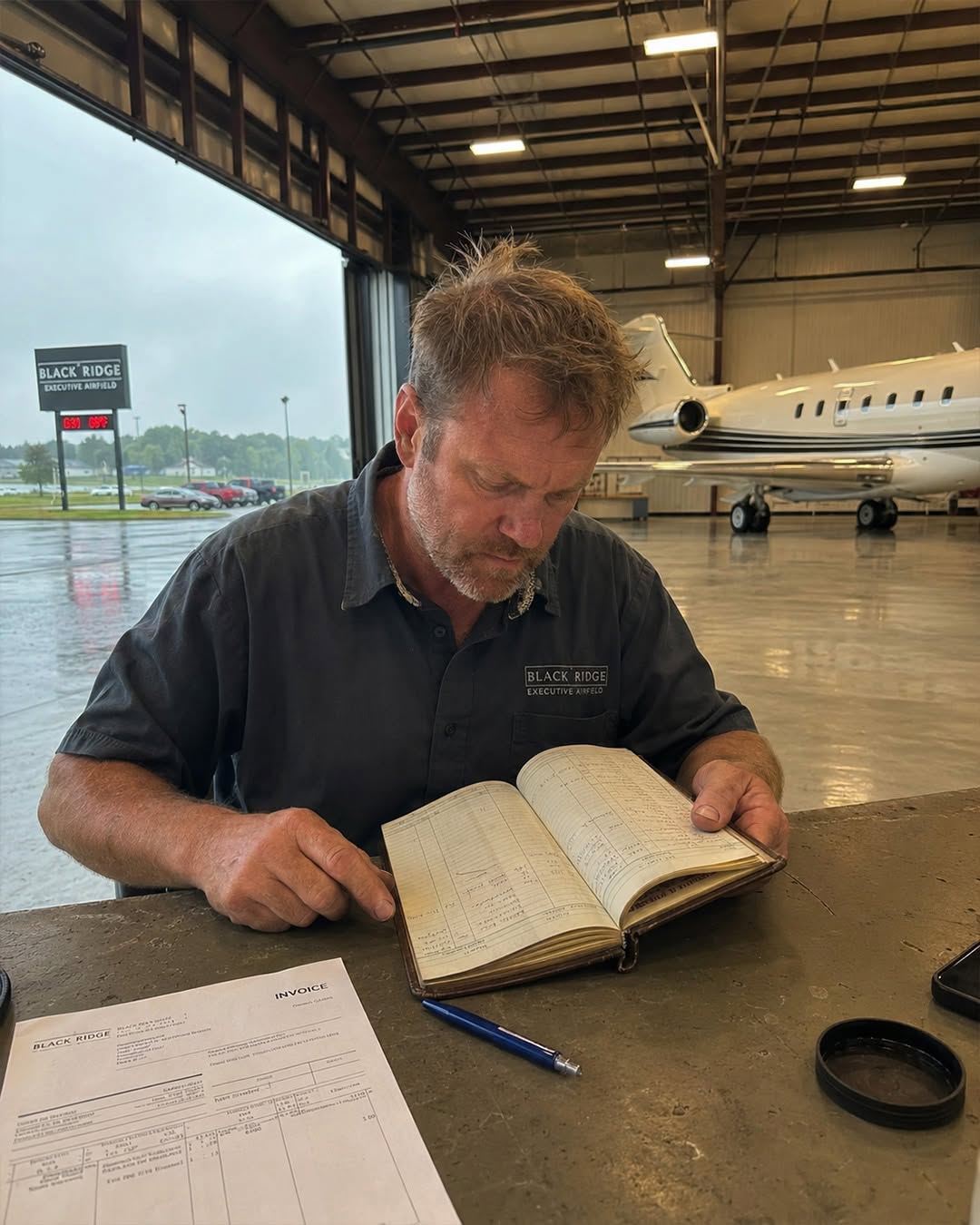
Odmówili zapłaty samotnemu ojcu, który odbudowywał ich odrzutowiec — wtedy żaden pilot nie zgodził się nim pilotować.
Faktura leżała płasko na stole konferencyjnym pod światłami hangaru, każdy element udokumentowany, każdy numer części przerysowany, każda godzina rozliczona w kwadratowym, starannym piśmie Evana Rourke'a.
Przez chwilę nikt go nie dotykał.
Odrzutowiec stał za szklaną ścianą Hangaru Siódmego, lśniąc pod świeżymi lampami inspekcyjnymi, a jego biały kadłub odbijał się w wypolerowanej betonowej podłodze. Sześć tygodni wcześniej samolot wyglądał na opuszczony: otwarte panele, odłączone przewody, brakujące wpisy w dzienniku, przewody hydrauliczne oznaczone przez trzech różnych techników, którzy nigdy nie dokończyli tego, co zaczęli. Teraz wyglądał na wystarczająco gotowy, by oszukać każdego, kto bardziej dbał o wygląd niż na dowody.
Evan znał różnicę.
Dlatego przyniósł fakturę w brązowej teczce, wraz z pełnym raportem o rozbieżności, dokumentacją śledzenia, oryginalną umowę, zmienioną wersją, której nigdy nie podpisał, oraz kopiami wszystkich zdjęć, które jego zespół zrobił od pierwszej nocy.
Miles Voss, dyrektor operacyjny Ashcroft Meridian Holdings, odchylił się w fotelu i uśmiechnął się, jakby spotkanie już się skończyło.
"Prosisz o dwieście czterdzieści tysięcy dolarów," powiedział Miles, jakby odczytywał kwotę z czeku na kolację, która wydawała się nierozsądna dla wina.
Evan siedział naprzeciwko niego w czystej roboczej koszuli, której kołnierz zaczynał się strzępić. Jego ręce były wyszorowane od rozpuszczalnika. Pod jednym paznokciem pozostała cienka linia tłuszczu, niezależnie od tego, jak mocno mył. Spał trzy godziny przez ostatnie dwie noce i miał nieotwarte zawiadomienie bankowe na kuchennym blacie w domu, bo już wiedział, co na nim jest napisane.
"Tak," powiedział Evan.
Miles raz stuknął w fakturę. "Za zlecenie, które przekroczyło budżet, spóźniło się z terminem dostawy i zawierało nieautoryzowane części."
Lena Brooks, stojąca za krzesłem Evana z założonymi rękami, lekko przeniosła ciężar ciała. Ktoś inny mógł to przeoczyć. Evan nie. Lena poruszała się tak tylko wtedy, gdy zastanawiała się, czy mówić, czy pozwolić komuś się w pełni ujawnić.
Vivien Ashcroft siedziała na drugim końcu stołu, CEO Ashcroft Meridian, córka zmarłego Conrada Ashcrofta i właścicielka Gulfstream G550 zaparkowana za szybą w każdym miejscu oprócz papierów. Jej wyraz twarzy był opanowany, ale Evan nauczył się przez ostatnie sześć tygodni, że jej bezruch nie zawsze jest pewny. Czasem to była kalkulacja. Czasem była to powściągliwość. Czasem, ostatnio, pojawiała się wątpliwość.
Miles przesunął drugi dokument przez stół.
"Nasz zespół prawny przeanalizował sprawę. Ostateczna wypłata jest wstrzymywana do czasu wewnętrznej kontroli."
Evan spojrzał na kartkę, ale jej nie podniósł.
"Wewnętrzny przegląd czego?"
"Naruszenia umowy. Opóźnienia. Nieregularności części. Potencjalne niewłaściwe wykorzystanie materiałów firmowych." Głos Milesa pozostał przyjemny. "Jesteśmy gotowi rozwiązać to czysto."
Otworzył skórzaną teczkę i położył jedną kartkę przed Evanem.
It was a release form.
Evan did not need to read past the first paragraph. The language was familiar. Too broad. Too smooth. A document designed to make a problem disappear by convincing the person most injured by it that disappearing was the practical choice.
Miles placed a pen beside it.
“Sign the aircraft’s airworthiness certification,” Miles said, “sign the release, and we’ll issue a courtesy payment of forty thousand dollars by close of business.”
The room went quiet.
Outside the conference room glass, two line technicians crossed the hangar and slowed without meaning to. Captain Grant Hale stood near the open logbook cart beside the aircraft, one hand resting lightly on the cover. He looked through the glass at Evan, then at the jet, then back down at the logbook as if its pages had more authority than anyone in the room.
Evan thought of Norah.
His daughter had called that morning from school to ask if he’d be home for dinner. She had tried to sound casual, but at sixteen, her voice still betrayed when she was worried. She knew about the mortgage because teenagers know everything adults try to hide badly. She knew Rourke Airworks had been living job to job since winter. She knew her father’s truck had needed tires since February and that he kept pretending the tread had “a little life left.” She knew, too, that if this invoice did not clear, the bank would stop sending warnings and start sending decisions.
Evan looked at the pen.
Then he reached into his shirt pocket and pulled out his certification card. He placed it beside the hangar key on the table.
Miles’s smile sharpened.
“Think carefully, Mr. Rourke.”
“I have.”
“You’re not in a strong position.”
“No,” Evan said calmly. “But the airplane isn’t either.”
Vivien’s eyes moved to him.
Miles’s smile slipped a fraction.
Evan picked up the release form and placed it back in front of Miles without signing it.
“I rebuilt the aircraft systems I was contracted to rebuild. I documented every part I touched. I advanced money for parts your office refused to approve on time. I logged an unresolved discrepancy on a flight-critical component installed before my team ever entered that hangar. Until that discrepancy is resolved by traceable documentation or physical replacement, I will not sign that aircraft into service.”
Miles leaned forward. “You understand what you’re risking.”
Evan took back his certification card.
“Yes,” he said. “That’s why the signature still means something.”
He left the hangar key on the table.
Then he stood, nodded once to Vivien, and walked out.
No raised voice.
No slammed door.
No speech.
Just the sound of his boots crossing the conference room, then the hangar floor, then the rain-slick parking lot beyond.
Ten minutes later, Vivien Ashcroft ordered the jet prepared for departure.
By then, no one in that room understood that the most powerful person at Black Ridge Executive Airfield was not the CEO, not the operations director, not the attorneys on speakerphone, not even the pilot with thirty years in the left seat.
It was the man who had walked away with his signature still in his pocket.
Six weeks earlier, Evan had driven through a cold Carolina rain to Black Ridge because he could not afford to ignore the call.
His repair shop, Rourke Airworks, sat on the edge of a smaller municipal field forty minutes outside Charlotte, in a low metal building with one good bay, one bad heater, and a hand-painted sign Norah had made when she was eleven. The letters were uneven, but Evan had refused to replace it.
Rourke Airworks
Aircraft Maintenance & Inspection
Do It Right Or Don’t Put Your Name On It
His late wife, Maria, had laughed the day Norah painted that line at the bottom.
“Subtle,” she said.
Evan had shrugged. “It’s accurate.”
Maria had been gone five years now, and the shop still carried her in odd places: the mug with a chipped blue rim near the coffee maker, the calendar habit she left behind, the way Evan kept receipts sorted by month because she used to say chaos was not a filing system just because he could find things in it.
After she died, people told Evan a lot of things.
That grief would pass.
That Norah needed him strong.
That the shop would survive if he worked hard enough.
The first two were complicated. The third turned out to be only partly true.
Hard work did not stop slow months. It did not make insurance premiums smaller. It did not make customers pay faster or parts cheaper or loan officers less interested in collateral. Evan worked anyway. He worked because the shop was his name, his daughter’s future, and the only thing he knew how to keep upright with both hands.
So when Miles Voss called and said Ashcroft Meridian needed urgent work on a grounded Gulfstream, Evan listened.
“The aircraft needs to be restored for flight within six weeks,” Miles said. His voice was clipped, efficient, and unburdened by the possibility of refusal. “We’ve had difficulty with scheduling at larger facilities.”
“That usually means the job is bigger than advertised,” Evan said.
A pause.
“The job is significant.”
“What happened to the aircraft?”
“Electrical and hydraulic issues. Prior work began but was interrupted.”
“Interrupted how?”
Another pause. “The previous vendor was replaced.”
Evan looked across his office at the bank envelope on his desk, the one he had not opened yet. “I’ll inspect before I agree.”
“Mr. Rourke, we’re prepared to pay a premium.”
“That doesn’t change the inspection.”
By sunset, he was inside Hangar Seven with a flashlight in one hand and rainwater dripping from his jacket onto the concrete.
The aircraft looked beautiful from twenty feet away.
Up close, it was a confession.
Panels were open and unlabeled. Wiring bundles had been disconnected and left without proper protective covers. Hydraulic fittings bore wrench marks from someone working too fast or with the wrong tools. A replacement accumulator carried no traceable part number. The maintenance logbook had gaps wide enough to park a truck in. Entire entries that should have covered thirty months of service were missing, summarized, or signed by initials Evan could not verify.
He stood beneath the nose of the jet, beam of light angled into the forward avionics bay, and said nothing for a long time.
Lena arrived the next morning.
She had worked beside him for eleven years and possessed the kind of patience that made careless people uncomfortable. She stepped into the hangar with a hard case of diagnostic equipment in one hand, a coffee in the other, and one look at the open bay made her stop.
“How bad?” she asked.
“Worse than they said.”
“That’s a low bar.”
Evan handed her a clipboard. “Start with avionics. I want photos before anything moves.”
“Do we have full records?”
“No.”
“So, terrible.”
“Possibly expensive.”
“That’s worse.”
He smiled despite himself. Lena had known Maria, had brought casseroles after the funeral, had fixed Norah’s old bike when Evan forgot the front brake was loose. She was the only person in his shop who could insult a situation and make it feel like a plan.
They brought in two additional technicians: Aaron Price and Martin Bell, both licensed, both trusted, neither fond of shortcuts. Evan divided the aircraft into zones and established one rule before anyone touched a tool.
“If it isn’t documented, it didn’t happen. If it doesn’t trace, it doesn’t stay. If anyone pressures you to move faster than the work allows, send them to me.”
The first week revealed enough problems to justify walking away.
The second week made walking away impossible.
Under the forward avionics rack, Evan found a component installed where a manufacturer-approved part should have been. It carried a serial number that matched no catalog entry in the manufacturer database. The mount was clean. Too clean. The installation appeared recent. Its position linked into a system affecting directional control response.
He called Lena over.
She crouched beside him, read the number, and went very still.
“That’s not a clerical mistake,” she said.
“No.”
“You want me to trace it?”
“I want you to trace everything like it.”
By day twelve, she found the supplier name buried in a purchase order archive that should have been easy to access and had not been.
Vanguard Aerosupply.
Incorporated three years earlier.
Paid more than four million dollars by Ashcroft Meridian’s aviation division.
Approved through procurement channels controlled by Miles Voss.
Lena printed the records and laid them in front of Evan without comment. He read through them standing beside the aircraft’s forward cabin, the paper warm from the printer, the ink slightly tacky under his thumb.
Inside the cockpit, tucked into a side pocket near the pilot’s seat, he had found an old photograph. Conrad Ashcroft stood beside the jet on a bright tarmac, one arm around a teenage Vivien. They were both squinting into the sun. Conrad looked less like the marble portrait in the company lobby and more like a father trying not to smile too much because his daughter was watching.
Evan returned the photo exactly where he found it.
He did not know Vivien then.
Not really.
He had met her twice. The first time, she came into the hangar in a damp trench coat and asked whether he could do what three larger firms had declined. Evan told her he could not promise the jet would be ready in six weeks. He could only promise it would not leave the hangar before it was safe.
She had stared at him as if deciding whether he was difficult or honest.
Maybe both.
The second time, she called to say she had concerns about cost and pace. Miles had been sending her one-paragraph summaries of Evan’s reports, edited so every safety discovery looked like an inconvenience and every delay looked like Evan’s poor management. When she arrived, Evan was on his back under a wiring conduit, pulling apart a connector because the torque felt wrong.
She watched in silence while he removed it.
He held up the contact with needle-nose pliers. It was bent deep enough inside the connector that a quick visual inspection would have passed it. Under vibration and heat, it could have created an intermittent autopilot signal fault.
Vivien looked at the tiny damaged piece.
Her face changed.
Only slightly.
“Would that have shown up before takeoff?” she asked.
“Maybe. Maybe not.”
“That’s not comforting.”
“It’s not supposed to be.”
She did not apologize for doubting him. But she stopped repeating Miles’s language after that.
By week three, Miles had begun withholding approvals for replacement parts over a thousand dollars. He called them review delays. Evan called them what they were: pressure. When the pressurization controller needed replacement and Miles insisted on a forty-eight-hour review, Evan used his own line of credit to order the part.
Lena found out when she saw the bank confirmation on his desk.
“Evan.”
“Don’t start.”
“You’re floating parts for a company that owns half the skyline in Charlotte.”
“I’m floating time. There’s a difference.”
“The bank doesn’t care about the difference.”
“No,” he said. “But that airplane will.”
Norah called that night while he was locking the shop.
“Are you eating real food?” she asked.
He smiled into the phone. “That’s my line.”
“You use it too much. I’m expanding the family brand.”
“I had a sandwich.”
“When?”
He looked toward the hangar door, where rain had started again in silver lines. “Recently adjacent.”
“Dad.”
“I’ll get something on the way home.”
She was quiet for a moment.
“Is this job going to fix the bank thing?”
He closed his eyes briefly.
Norah had Maria’s directness. She could circle a hard truth for about eight seconds, then she got impatient and walked straight into it.
“It’ll help,” he said.
“That’s not an answer.”
“It’s the one I have tonight.”
A pause.
“Then don’t let them mess with you.”
He laughed once. “Language.”
“I didn’t use language.”
“You implied language.”
“I’m serious.”
“I know.”
When he hung up, he stood in the doorway of Rourke Airworks looking at the shop floor, the old tool cabinets, the spare parts shelf, the photo of Maria and Norah taped to the office window. He had built the place to be small but honest. Lately, honest had begun to feel more expensive than small.
Still, neither the bank nor Miles Voss could change what Evan would or would not sign.
On day twenty-one, Miles came to the hangar with a revised schedule on company letterhead.
“The aircraft releases to flight operations Friday morning,” he said.
Evan was standing near the main landing gear, reviewing a hydraulic pressure test.
“No.”
Miles’s expression did not change. “That wasn’t a question.”
“It still has an answer.”
Vivien had come with him that evening, quiet in a gray coat, her hair pinned back, her attention moving between the men like she was trying to read not only what was being said but what had been said before she arrived.
Miles gestured toward the aircraft. “You’ve had three weeks.”
“And I’ve found six weeks of hidden problems.”
“You have also expanded the work beyond the scope.”
“The aircraft expanded the work. I just wrote it down.”
Miles turned to Vivien. “This is exactly what I warned you about. Every inspection reveals another problem because Mr. Rourke is incentivized to find them.”
Evan walked to his workbench, opened a small parts tray, and picked up a bolt sealed in a plastic evidence bag. He placed it on the tool chest between them.
“Compare that with the invoice for the directional linkage assembly.”
Vivien looked at him, then opened her tablet. Miles’s jaw tightened.
“Minor substitutions are standard,” Miles said before she had even found the document.
Evan did not look at him. “Then the specifications should match.”
Vivien read the invoice. Then she read the etched marking on the bolt through the plastic.
“They don’t,” she said.
Miles smiled faintly. “A procurement variation. Functionally equivalent.”
“No,” Evan said.
Miles turned on him. “You’re not the only mechanic in the state of North Carolina, Mr. Rourke.”
“No. But I’m the one holding the bolt.”
Vivien looked from the bolt to Miles.
For the first time, she did not seem uncertain. She seemed offended that she had been made uncertain by someone else’s version of the truth.
That night, after Miles left, Vivien returned alone with two coffees from the terminal café.
Evan was sitting on the maintenance steps, entering notes into his private log. The hangar was mostly dark except for work lights over the open panels. The jet stood silent above them, less like luxury now and more like a patient in a long recovery.
Vivien handed him one coffee.
“I owe you an apology,” she said.
Evan took the cup. “For what?”
“For reading summaries instead of reports.”
He studied her for a moment. “That’s a specific apology.”
“It’s a specific mistake.”
He nodded once.
She sat on the step below him, careful not to let her coat touch the floor. For a while, neither of them spoke.
Then she said, “My father loved this aircraft.”
Evan glanced toward the cockpit. “I found a photograph.”
“Of us?”
“By the pilot’s seat. I put it back.”
“He used to take me here on Saturdays when I was a kid,” she said. “I’d sit in the cabin and pretend we were going somewhere better than a hangar in the rain.”
“Did you?”
“Sometimes. Mostly we went to meetings where I had to sit quietly and color in the margins of his legal pads.”
Evan smiled faintly.
“He trusted machines more than people,” she said. “But when he trusted a person, he never forgot why.”
Evan thought of the photograph, of Conrad’s arm around a younger Vivien.
“Did he trust Miles?”
She did not answer right away.
“That is the question I am starting to ask.”
By morning, every Vanguard Aerosupply file had been deleted from the company maintenance server.
Lena discovered it at 6:40 and called Evan before he got through the hangar door.
“They wiped it.”
“Everything?”
“Vanguard folder. Purchase orders. Installation reports. Vendor history. Gone from the live server.”
“Backup?”
Her voice changed, just enough to make him breathe again.
“I cloned it yesterday.”
“Of course you did.”
“I like to be emotionally prepared for nonsense.”
Evan stood in the rain outside Hangar Seven and looked toward the building lights.
“Print everything,” he said. “Twice.”
“Already started.”
Three days before the scheduled departure, the altered contract appeared.
Miles sent it by email with a note saying legal had confirmed the deadline was binding and failure to deliver by Friday allowed Ashcroft Meridian to withhold final payment. Evan opened the attachment, read the penalty clause, then opened his own archived copy of the contract.
The original listed Friday as a target delivery date, subject to inspection findings.
The new version made it binding.
His initials appeared beside the revision.
They were not his initials.
Evan sat alone in the Rourke Airworks office at midnight with both documents open on the desk. The old heater clicked in the corner. Norah had left a paper plate covered in foil beside his keyboard. Turkey sandwich. Pickles. An apple. A sticky note on top.
Eat this or I’m calling Lena.
He smiled despite everything, ate half the sandwich cold, and scanned both contracts into the evidence folder.
The final two weeks of work did not look dramatic.
Bench calibrations. Pressure tests. Control surface checks. Continuity inspections. Software updates. Replacing what could be replaced, tracing what could not, verifying every redundant channel. It was slow, unglamorous work. The kind of work people only noticed when someone skipped it.
The morning the engines turned over for the first time, the sound moved through the hangar floor and up into Evan’s bones.
Aaron stopped what he was doing.
Martin looked up from the checklist.
Lena allowed herself one long breath, then marked the test result.
Vivien arrived while the auxiliary power unit was still running. She stood at the hangar entrance for several seconds before walking in, one hand pressed lightly against the lower fuselage as she passed.
Evan recognized the gesture.
People touch what they are afraid to lose.
“She sounds good,” Vivien said.
“She’s getting there.”
“Getting there?”
“Final verification isn’t complete.”
Miles, who had arrived behind her, made a visible effort not to react.
“We’re scheduled for wheels up tomorrow,” he said.
“No,” Evan answered.
Vivien turned.
“What remains?”
“Independent traceability confirmation on flight-critical components, final control response verification, and a clean airworthiness signoff.”
Miles gave a soft laugh. “Mr. Rourke has developed a talent for moving the finish line.”
Evan looked at him. “The finish line has always been safe.”
That evening, a technician loyal to Miles moved a box of old Vanguard components into the hangar storage room and placed it where it could be “found” later. Lena saw the storage entry alert on the internal access log and screenshotted it before the record could disappear.
By then, the trap had begun to close.
Evan submitted the invoice the next morning.
By noon, the meeting happened.
By one, Miles said Ashcroft Meridian would not pay.
By one-thirty, Evan walked out.
At eight the following morning, the sky over Black Ridge Executive Airfield was clear and cold.
Vivien arrived in a black car with a schedule that required wheels up at nine. She wore a navy suit, carried a leather briefcase, and had the controlled look of someone who had decided her uncertainty was over. Miles had briefed her before dawn. Evan had walked off the job. The aircraft was complete. Another technician could handle the certificate. The invoice dispute would be addressed later.
The terminal smelled like coffee and floor wax. Outside the glass, the Gulfstream sat ready-looking on the ramp, tug connected, cabin door open, sunlight turning the fuselage bright enough to hurt.
Captain Grant Hale stood in the hangar beside the maintenance logbook.
Grant had flown Conrad Ashcroft for twenty years and stayed on after his death because Vivien asked him to. He was fifty-five, quiet, broad-shouldered, with white at the edges of his dark hair and the unhurried manner of a man who had spent his life aware that altitude made arrogance expensive.
Miles approached him with a clipboard.
“Captain, we need pre-flight started immediately.”
Grant did not move.
“Certification?”
“Being handled.”
"Przez kogo?"
"Licencjonowany technik."
Grant ponownie otworzył dziennik i przeszedł do ostatniego wpisu Evana. Jego palec spoczywał na stronie.
"Za mało."
Ton Milesa się wyostrzył. "Samolot został odrestaurowany."
"Dziennik mówi, że pozostaje nierozwiązana rozbieżność."
"Pan Rourke nie jest już zaangażowany w projekt."
"To nie usuwa jego wpisu."