I looked out at the city skyline, steel and glass reflecting the cold sun.
I thought about the email.
We cannot accommodate you.
“He put himself there,” I said. “I’m just turning on the lights.”
I hung up.
The sadness was gone.
The hurt was gone.
All that was left was the cold, hard certainty of a diagnosis.
The infection was deep.
It was systemic.
And it was time to cut it out.
I drove north.
The city faded into suburbs, suburbs into highways, highways into the rugged, pine-lined roads of coastal Maine.
Four hours of silence.
No radio.
No podcasts.
Just the hum of the engine and the rehearsal of what I was about to do.
I arrived at the estate just as the sun was beginning to dip, casting long, bruised shadows across the driveway.
There were three cars parked on the gravel.
My father’s SUV.
My mother’s sedan.
And Jared’s convertible.
The convertible I knew he couldn’t afford.
I didn’t park in the guest spot.
I parked right in front of the garage, blocking them all in.
I walked up the stone path I had paid to have relaid two summers ago.
The front door was solid oak.
Imposing.
I reached into my pocket and pulled out my key.
I wondered briefly if they had changed the locks, but arrogance is often lazy.
They hadn’t.
The lock clicked.
The door swung open.
The house smelled of stale wine and expensive candles.
I walked into the great room.
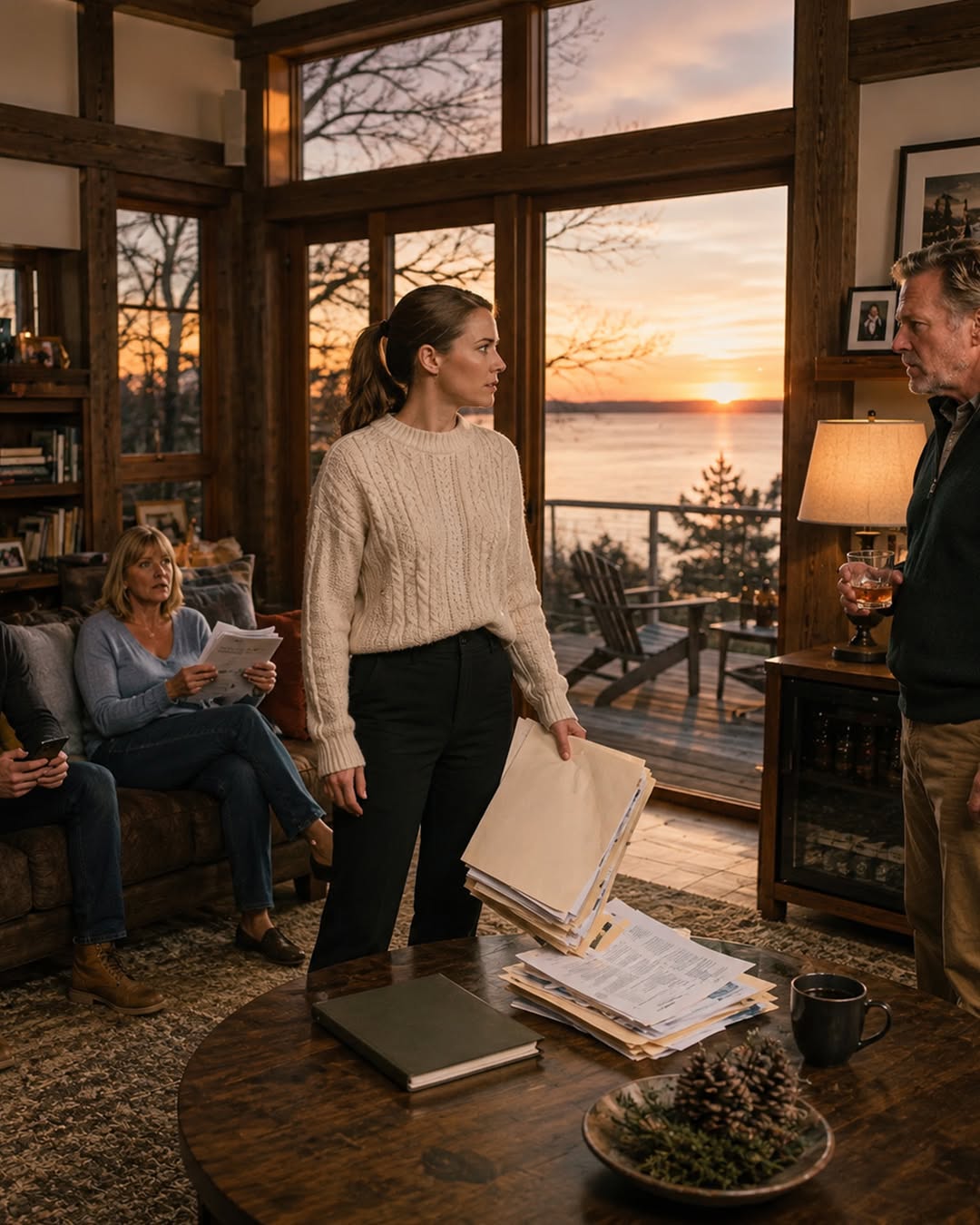
They were all there, lounging on the custom leather sectional.
Jared was on his phone, laughing.
My mother was flipping through a magazine.
My father was pouring a drink at the wet bar.
They froze.
The silence that fell over the room wasn’t awkward.
It was heavy.
“Morgan,” my mother stood up, clutching her magazine like a shield. “What are you doing here?”
“I have a key,” I said, my voice flat. “It’s my house.”
“It’s not your house,” Jared sneered, not bothering to stand. “You just co-signed. That doesn’t make you the owner, and you weren’t invited.”
“Actually,” I said, walking to the coffee table and dropping a thick manila folder onto the glass surface.
The sound was like a gavel strike.
“It makes me the primary financial guarantor. And since the mortgage payment bounced yesterday because I canceled it, and since you’ve defaulted on the terms of the loan by running an unregistered commercial enterprise on residential property…”
I paused, letting the legal weight of the words settle.
“I am exercising my right to secure the asset.”
My father slammed his glass down.
“Commercial enterprise? What are you talking about?”
I opened the folder.
The first page was a color printout of the Airbnb listing.
The Cliffside Estate, hosted by Jared Ventures LLC.
“$150,000 in revenue last year,” I said, looking directly at Jared.
His face went white.
“Not a dime of which went to the mortgage. Not a dime of which was declared to me.”
“That’s just a side thing,” Jared stammered. “Helping out with expenses.”
“You didn’t help with expenses,” I corrected him. “You profited from my liability. That’s fraud, Jared. And Dad, you let him do it.”
“This is a family home,” my father shouted, his face turning a dangerous shade of red. “You are trying to steal it from under us.”
“I’m not stealing it,” I said. “I’m repossessing it.”
The air in the room changed.
It shifted from annoyance to terror.
They realized, finally, that I wasn’t there to argue.
I wasn’t there to beg for an apology.
I was there to foreclose on their entitlement.
“You have until sunset,” I said. “Pack what you can carry.”
The silence that followed wasn’t peaceful.
It was the vacuum before a collapse.
My mother was the first to break it.
She didn’t scream.
She dissolved.
It was a tactical dissolution, the kind she had used for years to get her way.
Tears welling up in her eyes, hands trembling, voice dropping to a wounded whisper.
“Morgan, please,” she said, reaching for my arm, but stopping short when I didn’t flinch. “You can’t do this. We’re your family. We just had a party. The house is full of food. Where are we supposed to go?”
“I don’t know,” I said. “Maybe you can rent an Airbnb. I hear Jared knows the market well.”
“This is cruel,” my father spat, stepping between me and my mother. “You’re doing this out of spite because you weren’t invited to a barbecue. You’re going to evict your own parents over a bruised ego.”
“I’m evicting you over fraud,” I corrected him. “And it’s not spite.”
“I won’t leave,” Jared said, crossing his arms.
He was trying to look defiant, but he looked like a child caught stealing from the register.
“I have tenants coming next week. A corporate retreat. They paid $6,000 upfront. I can’t just cancel.”
“You already canceled,” I said. “I contacted the platform an hour ago with the deed and the police report number I filed for identity theft regarding the utility bills. The listing has been suspended. The money is being refunded from your account.”
Jared’s phone buzzed in his pocket.
He pulled it out, stared at the screen, and the defiance drained out of him like water from a cracked glass.
“You reported me to the police,” he whispered.
“Not yet,” I said. “I filed a report to establish ownership. The fraud charges, those are pending.”
I pulled my phone out and placed it on the coffee table.
I dialed a number and hit speaker.
It rang once.
“This is Catherine.”
My lawyer’s voice filled the room, crisp and professional.
“Catherine, I’m with the occupants,” I said. “They are refusing to vacate.”
“Certainly,” Catherine said. “If the occupants do not vacate the premises voluntarily within the hour, we will proceed with filing criminal charges against Jared Ventures LLC for wire fraud, bank fraud, and grand larceny. Given the amount over $150,000, we are looking at a mandatory minimum sentence of 10 years in federal prison. We will also be naming Brian and Susan as accessories to the crime, as they knowingly facilitated the enterprise on a property they did not own.”
The room went dead silent.
The only sound was the hum of the refrigerator and the wind battering the windows.
“Ten years?” my mother gasped.
She looked at Jared.
“Brian,” she pleaded.
My father looked at me.
He was searching for the daughter who used to seek his approval.
The girl who would do anything for a pat on the head.
He didn’t find her.
He found a landlord.
“Pack the car,” he said, his voice hollow.
“Dad,” Jared protested.
“Pack the car,” Brian roared, the veins in his neck bulging. “Do you want to go to jail? Because she’ll do it. Look at her face. She’ll do it.”
It took them 40 minutes.
I stood by the door, watching.
I didn’t help.
I didn’t hinder.
I just witnessed.
They threw clothes into garbage bags.
They grabbed the expensive wine.
They took the leftover catering trays.
It was a chaotic, humiliating retreat.
When the last bag was in the trunk of my father’s SUV, he turned to me on the porch.
The wind was whipping his hair, making him look smaller, older.
“You’ve destroyed this family,” he said.
“No,” I replied, closing the heavy oak door between us. “I just stopped subsidizing it.”
I turned the deadbolt.
The click echoed through the empty house.
It was the loudest sound I had ever heard.
And it sounded exactly like freedom.
The silence after they left was absolute.
The house, usually filled with the noise of their entitlement, was now just a shell of wood and stone.
I walked through the empty rooms.
I saw the scuffs on the floor where they had dragged their furniture.
I saw the empty wine bottles in the recycling bin.
I saw the ghost of the family I had tried to buy for five years.
I spent the next three days cleaning.
I scrubbed the floors until my knees ached.
I washed the windows until the salt spray was gone.
I stripped the beds and donated the linens.
I was sanitizing the wound.
I was preparing the patient for recovery.
I didn’t sell the house.
That would have been the easy financial decision, the logical end to a bad investment.
But I wasn’t interested in logic anymore.
I was interested in healing.
I called Catherine, my lawyer, on Friday morning.
“I want to restructure the ownership,” I said. “I’m not selling. I’m donating the use of the property.”
“Donating?” she asked. “To whom?”
“To the healers who are drowning,” I said. “I want to turn this place into a respite center, a retreat for crisis nurses, trauma surgeons, first responders, people who spend their lives saving others and have nowhere to go when they need saving themselves. I want to offer it to them for free. A week of silence, a week of peace, a week where no one asks them for anything.”
“That’s generous,” Catherine said, her voice softening. “And the operating costs?”
“I’ll cover them,” I said. “It costs less than supporting a family that hates me.”
I renamed the estate.
It wasn’t The Cliffside Estate anymore.
It was The Haven.
Six months later, the first guest arrived.
She was an ER nurse from Chicago who had worked through the worst of the pandemic and hadn’t slept a full night in two years.
I met her at the door, not as a landlord, but as a colleague.
I gave her the key.
I told her the fridge was full.
I told her the ocean was hers.
When she cried, I didn’t offer empty platitudes.
I just let her cry, because I knew that sometimes, the only way to heal is to finally be allowed to fall apart in a safe place.
My family tried to reach out when the news hit the local paper.
They saw the article about the nurse who donated her million-dollar view.
Widzieli pochwały.
Pewnie zobaczyli sposób, by wrócić.
Nie odbierałem ich telefonów.
Nie czytałem ich listów.
Zbudowałem sanktuarium.
A pierwsza zasada sanktuarium: nie wpuszczasz wilków z powrotem.